
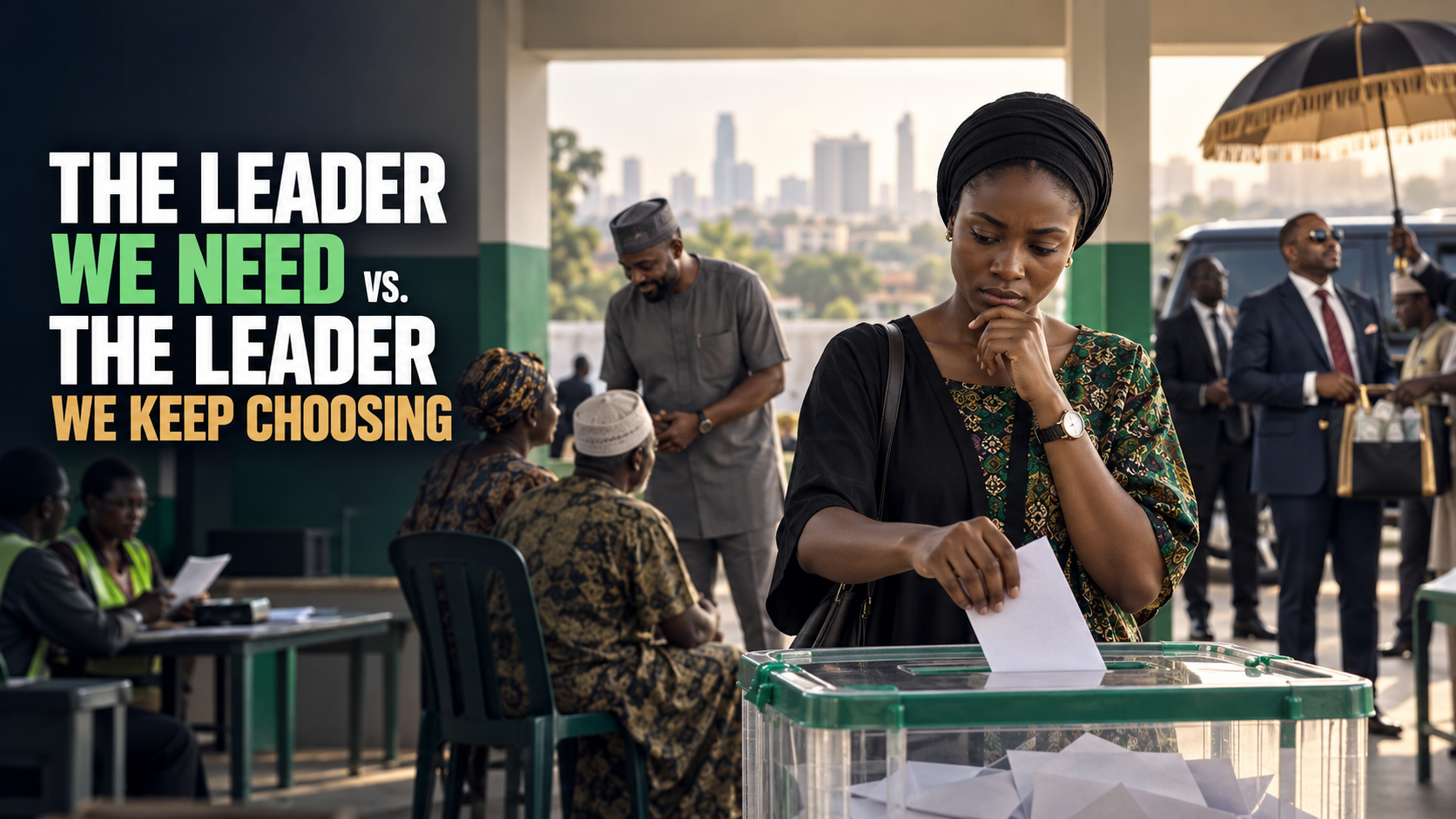
We complain about our leaders.
We complain about bad roads, unreliable electricity, unemployment, insecurity, corruption, inflation, failing institutions and the rising cost of living.
We complain about politicians who make promises during campaigns and disappear after elections. We complain about leaders who seem to forget the people who gave them power.
Many of these complaints are justified.
But there is one uncomfortable question we do not ask often enough:
Who keeps choosing these leaders?
The Other Side of the Leadership Crisis
In my book, Burden of Followership, I argue that we cannot discuss leadership honestly without examining the responsibility of those who follow, support, tolerate and ultimately legitimise leaders.
We are quick to ask, “Where are the good leaders?”
Perhaps we should also ask:
What do we do when we are given the opportunity to choose them?
Nigeria’s leadership crisis is not only a crisis of politicians. It is also a crisis of citizens who sometimes choose leaders based on ethnicity, religion, money, familiarity, sentiment or political loyalty—and then demand competence from the same people they helped put in power.
We cannot plant weeds and complain that the harvest is poor.
This does not excuse bad leadership. Leaders must be held accountable for their decisions, failures and abuse of power. But citizens must also recognise that elections are not spectator sports.
They are moments of collective responsibility.
Our Responsibility Begins Before Election Day
Many people behave as though their electoral responsibility begins and ends with collecting a Permanent Voter’s Card and casting a ballot.
It does not.
Our responsibility begins long before election day.
Before supporting a candidate, we should ask:
- What do we know about this person’s record?
- What have they done with previous positions of responsibility?
- What have they actually built or improved?
- What values do they demonstrate?
- What are their plans for education, healthcare, security, employment and the economy?
- Do they have the competence and character required for the office?
- Would we still support them if we were not personally benefiting from their political success?
That last question may be the most important.
Would we still defend the candidate if they were not from our community, state, religion, ethnic group or political party?
Would we still consider them qualified if there were no money, contracts, appointments or favours attached to their success?
These questions are difficult because identity has become more powerful than competence in Nigerian politics.
We say:
“He is our person.”
“She is from our state.”
“He is a Christian.”
“She is a Muslim.”
“He is from the North.”
“She is from the South.”
“He belongs to my party.”
Somewhere along the way, we forget to ask whether the person is capable of leading.
A country cannot develop simply because the person in power belongs to our ethnic group.
A road does not become better because the governor shares our religion.
A hospital does not become functional because the minister comes from our region.
Unemployment does not disappear because the president is “our person.”
Leadership should not be a reward for identity. It is a responsibility that demands competence, character and service.
Followership Is the Other Side of Leadership
In The Trouble with Nigeria, Chinua Achebe famously identified leadership failure as Nigeria’s central problem. That argument remains powerful, but perhaps we must take the conversation one step further.
If leadership is one side of the equation, followership is the other.
A society does not merely receive its leaders. Over time, it helps create the political environment in which certain types of leaders succeed.
If citizens reward money politics, politicians will bring money.
If citizens reward ethnic loyalty, politicians will mobilise ethnicity.
If citizens reward religious sentiment, politicians will weaponise religion.
If citizens overlook incompetence because a candidate is “our person,” incompetence becomes politically profitable.
And when citizens sell their votes today, they may be giving politicians permission to steal their tomorrow.
Vote buying creates a dangerous relationship between politicians and citizens. Once a candidate believes they have purchased electoral support, they may feel less obligated to remain accountable after taking office.
The immediate benefit may be cash, food or gifts. The long-term cost is often weaker governance, neglected communities and public resources treated as personal property.
This is the paradox of transactional politics.
We sell our votes for a little money and then complain that there is no money.
We accept bags of rice during campaigns and then complain that public institutions are starving.
We support candidates because of their connections and later complain when those same connections determine who receives opportunities.
We defend politicians because they belong to our political camp and then complain when the government fails us.
We cannot continue this cycle while pretending that citizens have no responsibility.
Democracy Cannot Survive on Spectators
Not every Nigerian voter is responsible for everything the government does.
Elections can be flawed. Citizens may face intimidation. Votes may be manipulated. Political choices can be limited by poor alternatives. Vote buying, misinformation and powerful political interests can distort the electoral process.
These realities must be acknowledged and confronted.
However, they should not become an excuse for abandoning our responsibility entirely.
One of the most dangerous attitudes in a democracy is:
“My vote will not change anything.”
That belief causes people to stay at home. They refuse to register, investigate candidates, participate in civic conversations or monitor the government.
Then, after the election, they become some of the loudest critics.
This is the contradiction we must confront: we cannot disappear when our responsibility is required and reappear only when it is time to complain.
Democracy cannot survive on spectators.
It needs citizens.
Citizens who ask difficult questions.
Citizens who investigate claims.
Citizens who participate consistently.
Citizens who challenge misinformation.
Citizens who reject vote buying.
Citizens who monitor public officials after elections.
Citizens who hold leaders accountable—even when those leaders belong to their preferred party.
Voting is important, but citizenship does not end at the ballot box. Elections determine who enters office; public accountability influences what they do when they get there.
The Leader We Need Is Not Always the Leader We Choose
Most Nigerians still want elections to be the means through which leaders are chosen, even as many remain dissatisfied with how democracy is being practised.
That tells us something important.
The problem is not necessarily that Nigerians have completely stopped believing in democracy. Many have lost faith in the way our democratic system functions.
Rebuilding that faith will require more than better politicians.
It will also require better followership.
The leader we need is not always the leader we choose.
Sometimes the painful truth is that we knowingly choose leaders we should reject.
We know the allegations.
We know their history.
We know their record of incompetence.
We remember the broken promises.
We have seen their character.
But we still say, “At least he is our person.”
Then the consequences eventually arrive at our doorstep.
Perhaps Nigeria’s future depends partly on changing the questions we ask.
From “Is he our person?” to “Will he be accountable to all of us?”
From “What will she give us?” to “What will she build?”
From “How much did he give me?” to “What will his leadership cost the country?”
From “Which party does she belong to?” to “What has she accomplished?”
From “Who is supporting him?” to “What does he stand for?”
These are the questions of responsible citizenship.
Choosing the Competent Over the Familiar
The leader we need may already exist.
The question is whether we will recognise that person when the time comes—and whether we will have the courage to choose them when doing so costs us something.
Sometimes the best candidate will not give us money.
They may not belong to our ethnic group.
They may not share our religion or speak our language.
They may not flatter us or tell us everything we want to hear.
They may not have the largest political structure, the loudest supporters or the most powerful godfathers.
Choosing them may require us to reject the familiar for the competent.
That is where citizenship becomes more than complaining.
We cannot demand leaders with integrity while rewarding dishonesty.
We cannot demand competence while voting based purely on sentiment.
We cannot demand accountability while excusing failure.
We cannot demand change while repeatedly choosing the same patterns that produced the problems we condemn.
Leadership matters.
But so does followership.
The leader has a responsibility to govern well. The follower has a responsibility to choose wisely, participate responsibly and hold power accountable.
Perhaps Nigeria does not only need better leaders.
Perhaps Nigeria also needs citizens who are finally prepared to choose better leaders.
The next time we ask, “Why did they give us this kind of leader?” we should have the courage to ask another question:
Who gave that leader the mandate?
And, more importantly:
What will we do differently when we are given the opportunity to choose again?
We complain about our leaders.
We complain about bad roads, poor electricity, unemployment, insecurity, corruption, inflation, failing institutions and the rising cost of living.
We complain about politicians who make promises during campaigns and disappear after elections.
We complain about leaders who have forgotten the people who voted for them.
And sometimes, our complaints are completely justified.
But there is a question we do not ask often enough:
Who keeps choosing these leaders?
This is where the burden of followership becomes uncomfortable.
In my book, Burden of Followership, I argue that leadership cannot be discussed honestly without examining the responsibility of those who follow, support, tolerate and ultimately legitimize leaders.
We are quick to ask, “Where are the good leaders?”
Perhaps we should also ask, “What are we doing when we are given the opportunity to choose them?”
Nigeria’s leadership crisis is not only a crisis of politicians. It is also a crisis of citizens who sometimes make choices based on sentiment, ethnicity, religion, money, familiarity or political loyalty, and then demand competence from the person they helped put in power.
We cannot plant weeds and complain that the harvest is poor.
That is not an excuse for bad leadership. Leaders must be held responsible for their actions. But citizens must also accept that elections are not spectator sports. They are moments of collective responsibility.
INEC itself describes voting, registration, orderly participation and encouraging others to participate as responsibilities of citizens within the electoral process.
The problem is that we often treat elections as if our responsibility ends when we collect our PVC and cast our ballot.
It does not.
Our responsibility begins long before election day.
Who are we supporting?
Why are we supporting them?
What do we know about their record?
What do they believe?
What have they actually built?
What have they done with power before?
What are their ideas for education, healthcare, security, employment and the economy?
And perhaps the most important question:
Would we still support this person if we were not benefiting personally from their political success?
These are difficult questions because Nigerian politics has often made identity more powerful than competence.
We say, “He is our person.”
“She is from our state.”
“He is a Christian.”
“She is a Muslim.”
“He is from the North.”
“She is from the South.”
“He belongs to my party.”
And somewhere along the way, we forget to ask whether the person is capable of leading.
A country cannot develop simply because the person in power belongs to our tribe.
A road does not become better because the governor shares our religion.
A hospital does not become functional because the minister comes from our region.
Unemployment does not disappear because the president is “our person.”
Leadership is not supposed to be a reward for identity.
It is a responsibility to competence, character and service.
Chinua Achebe, in The Trouble with Nigeria, famously argued that the trouble with Nigeria is fundamentally a failure of leadership. That argument remains powerful, but perhaps our conversation must go one step further.
If leadership is one side of the equation, followership is the other.
A society does not merely receive the leaders it has. Over time, it helps create the political environment in which certain kinds of leaders succeed.
If citizens reward money politics, politicians will bring money.
If citizens reward ethnic loyalty, politicians will mobilize ethnicity.
If citizens reward religious sentiment, politicians will weaponize religion.
If citizens overlook incompetence because “he is our man,” incompetence becomes politically profitable.
If citizens sell their votes today, they may be giving someone permission to steal their tomorrow.
Research by Chatham House has found that vote trading in Nigeria can create a relationship in which politicians become less accountable to citizens after buying electoral support. The immediate benefit may be cash or gifts, but the long-term cost can be weaker governance and greater corruption.
This is the paradox.
We sell our votes for a little money.
Then we complain when there is no money.
We accept bags of rice during campaigns.
Then we complain when public institutions are starving.
We support candidates because of their connections.
Then we complain when those same connections determine who gets opportunities.
We defend politicians when they fail because they belong to our political camp.
Then we complain when government fails us.
We cannot continue this cycle and pretend that citizens have no responsibility.
Of course, this does not mean every Nigerian who votes is responsible for everything a government does. Elections can be flawed. Citizens can be intimidated. Votes can be manipulated. Political choices can be constrained by poor alternatives. Nigeria’s electoral environment has also been affected by vote buying, intimidation and powerful political interests.
But acknowledging these realities should not become an excuse for abandoning our own responsibility.
Because there is another dangerous attitude:
“My vote won’t change anything.”
So people stay home.
They refuse to register.
They do not investigate candidates.
They do not participate.
They do not monitor government.
And after the election, they become the loudest critics.
This is the contradiction we must confront.
You cannot disappear when your responsibility is required and reappear only when it is time to complain.
Democracy cannot survive on spectators.
It needs citizens.
Citizens who ask questions.
Citizens who research.
Citizens who participate.
Citizens who challenge misinformation.
Citizens who reject vote buying.
Citizens who hold leaders accountable even when those leaders belong to their preferred party.
Afrobarometer has found that most Nigerians still prefer elections as the best way to choose leaders, even while many express deep dissatisfaction with how democracy is working.
That tells us something important.
The problem is not necessarily that Nigerians have stopped believing in democracy.
The problem is that many Nigerians have lost faith in the way we practise it.
And rebuilding that faith requires more than better politicians.
It requires better followership.
The leader we need is not always the leader we choose.
And sometimes, the painful truth is that we choose the leader we already know we should not choose.
We know the allegations.
We know the history.
We know the lack of competence.
We know the broken promises.
We know the character.
But we say, “At least he is our person.”
Until the consequences arrive at our doorstep.
Perhaps the future of Nigeria depends partly on changing that sentence.
From “He is our person” to “He is accountable to all of us.”
From “What will he give us?” to “What will he build?”
From “How much did he give me?” to “What will his leadership cost the country?”
From “Which party does he belong to?” to “What has he done?”
From “Who is supporting him?” to “What does he stand for?”
This is not merely a Nigerian problem.
Across Africa, citizens continue to wrestle with questions of political accountability, democratic participation and the quality of leadership. But countries that want stronger institutions cannot build them through leaders alone. Institutions become stronger when citizens understand that democracy is something they participate in, not something they watch.
The leader we need may already exist.
The question is whether we are mature enough to recognize that person when the time comes.
And whether we are courageous enough to choose them when choosing them costs us something.
Because sometimes the best candidate will not give us money.
Sometimes they will not belong to our tribe.
Sometimes they will not speak our language.
Sometimes they will not flatter us.
Sometimes they will not have the biggest political structure behind them.
Sometimes choosing them will mean rejecting the familiar for the competent.
That is where citizenship becomes more than complaining.
The truth is simple but uncomfortable:
We cannot demand leaders with integrity while rewarding dishonesty.
We cannot demand competence while voting based on sentiment.
We cannot demand accountability while excusing failure.
We cannot demand change while repeatedly choosing the same patterns that produced the problems we complain about.
Leadership matters.
But so does followership.
The leader has a burden to lead well.
The follower has a burden to choose wisely, participate responsibly and hold power accountable.
Perhaps Nigeria does not only need better leaders.
Perhaps Nigeria needs citizens who are finally prepared to choose better leaders.
Because the next time we ask, “Why did they give us this kind of leader?”
We should also have the courage to ask:
“Who gave them the mandate?”
And even more importantly:
“What will we do differently when we are given the choice again?”


